
How to send photos has become a daily question for millions of people. Family memories, special events, spontaneous moments—we all want a simple way to share them through a secure, fast, and reliable photo album. But when you need to send multiple high-quality photos to several people while protecting your privacy, challenges quickly emerge. Between technical limitations, loss of control, and security risks, choosing the right solution matters more than ever.
Send a large number of photos to multiple contacts
 Sending a large number of photos to multiple contacts is often more complicated than it seems. Many users start with the obvious solutions: email, instant messaging, or social media. And very quickly, problems arise.
Emails reject attachments that are too large, messaging apps compress images or limit file numbers, and social networks impose their own distribution rules.
Users always ask the same questions, particularly regarding data protection and privacy. How to send photos privately? What about the security of photos and videos posted on these platforms?
Other concerns emerge when you realize these American services aren’t reliable—and are actually the most dangerous when used as personal albums…
The problem mainly stems from the fact that most tools weren’t designed for bulk photo sending. They’re built for messaging, public posting, or personal storage—not structured private sharing. The result? You improvise, work around limitations, and accept compromises that shouldn’t exist.
The problem mainly comes from the fact that most of the tools used are not designed for mass photo sending. They are designed for discussion, public posting or personal storage, but not for structured private sharing. Result: you improvise, you work around it, you accept compromises that should not exist.
A truly suitable solution allows you to send all photos at once to multiple contacts, without artificial limits or complicated steps. Photos are centralized, accessible to all authorized recipients, and remain available over time. Photo sharing then becomes simple, logical, and seamless—exactly what users expect today.
What is the maximum weight and quality for photos?
Photo size and quality are central concerns when sending large numbers of images.
Modern smartphones and cameras produce increasingly high-resolution files with excellent detail. This is great for preserving clear, detailed memories, but problematic for traditional sharing solutions. Many users realize—sometimes too late—that their photos have been automatically compressed.
Colors become less accurate, details disappear, and images become unsuitable for printing or archiving. This quality loss is often imposed without warning, simply to ease transfers or reduce platform storage costs. The questions keep coming: why do my photos look different after sending? Why do I have to reduce their size to share them? Why do some platforms force me to choose between speed and quality? Photo sharing shouldn’t mean degrading your memories.
A sharing solution designed for this purpose lets you send photos in their original quality, without lossy compression, regardless of file size.
This completely transforms the user experience. Photos stay true to the original, videos retain their clarity, and everyone can view or download files without any surprises. Sending high-quality, large files then becomes a non-issue. Users focus on what matters: sharing their content, without worrying about technical constraints or limitations from unsuitable tools.
How to control access to photos and prevent transfer?

– Who can see the photos? Who shouldn’t have access? Can you limit certain images to a restricted circle?
These questions are fundamental, especially when dealing with personal, family, or sensitive photos.
On social media and certain apps, control is often unclear. Privacy settings are complex, change frequently, and sometimes create a false sense of security.
A photo shared in a supposedly private context may end up being copied, reshared, or visible to unintended people. Once posted, it’s often too late to regain control. Data protection authorities regularly remind us that posting or sharing photos online is never trivial. An image can reveal personal information, faces, locations, or daily habits.
Sending photos without precise access control unnecessarily exposes the people involved, sometimes without their knowledge. A true private sharing space lets you clearly define everyone’s permissions. Users decide who can see what, without ambiguity. They can organize their photos, manage access by contact, and modify or revoke permissions at any time.
Photo sharing becomes a controlled act, respectful of privacy and image rights. This control is now a strong expectation from users, increasingly aware of privacy and personal data protection issues.
Cloud, social networks and photo sharing applications

In reality, these sites are not designed for secure private sharing.
Their business model is based on collecting, analyzing and exploiting data, including personal content.
The recommendations of the CNIL and gouv.fr are clear: you must be extremely careful when sharing personal photos and videos online.
Once hosted on these platforms, images can be kept for a long time, analyzed, or even used for purposes other than simple sharing between loved ones.
Send photos to clouds and publish on networks: what are the dangers?
Contrary to popular belief, these risks do not only concern elderly people or those unfamiliar with digital technology. Everyone can be affected. Sending photos via platforms not dedicated to private sharing amounts to accepting significant compromises on security and privacy.
- commercial exploitation of photos and personal data
- indirect hacking through a friend’s or contact’s account
- identity theft from recovered photos
- loss of control over distribution and storage duration
- storage subject to US laws and expanded access
- exposure to scams, fake profiles, viruses and malware
- very poor confidentiality
- dangers to your privacy and right to image
Send or publish your photos in a shared private space?
It’s important to distinguish between one-off photo sending and publishing them in a shared private space.
Sending photos one by one through different channels eventually creates confusion.
Photos get lost, links expire, and everyone ends up with a different version of the same memories. A shared private space lets you centralize photos and videos in one secure location. Authorized contacts can access it whenever they want, without needing to request a new send or immediately download files.
This greatly simplifies sharing, especially when photos are sent regularly.
This approach is particularly suited to families, loved ones, or groups who wish to share memories over time. Photo sharing then becomes a simple action, integrated into an organized space, without relying on tools designed for something else. Publishing your photos in a private space also means choosing peace of mind. No ads, no algorithms, no intrusive suggestions.
Just photos and videos shared with the right people in a respectful and secure environment.
Exchange and share photos peacefully, it’s possible
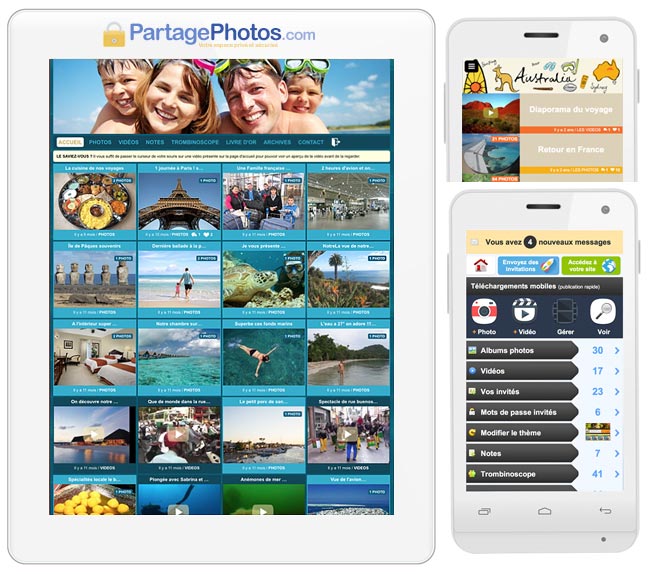 Sending photos to multiple contacts, in large numbers, without losing quality and without endangering your privacy, should not be an uphill battle. Yet, the most well-known solutions are not suitable for this use and expose users to many risks.
This is precisely to meet these needs that our private online photo sharing service was designed. The platform allows you to send and share photos and videos in a private, secure space, GDPR compliant and designed for family and personal use.
Unlike social networks and American clouds, the goal is not data exploitation, but content protection and ease of use. In the same logic, creerunblogprive.com is a particularly interesting alternative for those who wish to go even further.
This service allows you to create a true private online space, dedicated to sharing photos and videos, without ads, without algorithms and without dependence on large American platforms like Google Photos, WhatsApp or iCloud.
The tool offers a clear, controlled and sustainable framework, where each piece of content remains under the control of its author. Sending photos thus becomes a simple and secure pleasure again, in the service of sharing and memories, not exposure or loss of control.
Say goodbye to social media risks
Create your 100% private photo sharing space in 2 minutes to share photo albums and videos with your contacts securely
✅ Create Your SpaceHow do I send multiple photos to several people at once?
Use a private photo sharing platform that allows bulk uploads and multiple recipient invitations. Unlike email or messaging apps with size limits, dedicated platforms let you send unlimited high-resolution photos to your entire contact list simultaneously without compression or quality loss.
What's the best way to share photos without losing quality?
Choose a service that preserves original file quality without automatic compression. Avoid social media and messaging apps that reduce resolution. Look for platforms offering lossless uploads, original file downloads, and no size restrictions on individual photos or albums.
Can I share photos privately without using social media?
Yes, private photo sharing platforms provide secure alternatives to social media. You control exactly who sees your photos through individual access permissions, without algorithms, ads, or data harvesting. Your photos remain in a closed environment accessible only to your invited contacts.
How can I share family photos securely online?
Use a European-hosted private sharing service with strong privacy protections and GDPR compliance. Ensure the platform offers granular access controls, secure encrypted storage, and doesn't sell your data to third parties. Avoid American platforms that monetize user content and personal information.
Why do my photos look different after sending them?
Most messaging apps and social platforms automatically compress photos to save bandwidth and storage costs. This compression reduces file size but degrades image quality, affecting colors, details, and print resolution. Use services designed for photographers that maintain 100% original quality without destructive compression.
Other searches on: « How to Send Photos »
- How to send photos without social networks?
- What free site to send photos to our family
- Create a link to send photos to your private contacts for a wedding
- Best idea for sending photos safely
- How to send photos high res without any cloud
- I want to know how to send photos to my friends without creating an account
- A password-protected sharing space for sharing photos
- What private sharing service for sending photos online
- How to send photos by email without blocking?
- How to create a private photo gallery without sending photos?
Also Read: About protecting your data on the Internet (CNIL)
