
Cloud backup, social networks, blog, secure photo platform… it’s not easy to choose the right online sharing solution. Indeed, for most internet users around the world, backing up files online has become an essential gesture to protect their memories and important documents. However, between cloud platforms, social networks and specialized services, it can be difficult to make the right choice. In this article, we explore the different options for secure photo storage that suits your needs.
What is a cloud backup?
Making a cloud backup is the act of storing files on servers accessible via the internet, rather than on a local hard drive or USB key.
 Files are uploaded online to a storage structure belonging to a cloud service provider. Once saved, your data remains available at any time and from any device connected to the internet. This helps prevent data loss in case of device failure, theft, or technical issues.
These backups are often automated, which can be an advantage, but also a disadvantage. This means you don’t have to think about it once the service is configured but also that all of your files will be shared to the cloud, without necessarily being able to decide what you want to delete, modify or control at the time of transfer.
For example, if you take a photo with your smartphone, it can be sent directly to the cloud without you having to do anything. For certain private photos such as family or very personal photos/videos, this can obviously be a problem.
When you haven’t decided that certain files could end up in your cloud backup and you would have, for example, preferred to store it on a USB key or on a local hard drive, it becomes quite complicated to have to examine your entire cloud backup to delete what you don’t want to keep online. We’ll return to this point a little further down in our article.
Some advantages but many disadvantages…
You’ve understood it, if this can at first glance guarantee that your memories, documents and other important files are always protected, you must be aware that a cloud backup can lead to in terms of privacy protection and personal data security.
We are far from having the guarantee of maintaining control when using a cloud backup such as those proposed by American multinationals.
Companies and individuals are increasingly using this solution for its simplicity and convenience. Cloud services also often offer tools to organize your files, share them or retrieve them quickly if needed.
Finally, one of the great advantages of the cloud is that it allows data redundancy. This means your files are often copied to multiple servers, further reducing the risk of loss. However, it is important to carefully choose your service provider to ensure that data remains secure. That’s the introduction, we will now examine different points of view regarding cloud backup.
What are the most well-known clouds?
Many cloud platforms exist today. Some of them have become world references. One of the most famous is iCloud, developed by Apple. This service is particularly popular with iPhone and Mac users because it integrates easily into the Apple ecosystem.
Dropbox is another well-known solution, appreciated for its simplicity (but not its many bugs) and its many file sharing features. Google Drive, for its part, is widely used because of its direct link with Google tools, such as Gmail or Google Photos.
Microsoft also offers a powerful solution with OneDrive, which integrates perfectly with the Office suite. These services allow you to back up and synchronize documents, photos or videos, depending on each person’s needs. Amazon Drive is another option, less well-known, but highly appreciated for its unlimited photo storage space in some of its offers.
American clouds, such as iCloud photos, Dropbox or Google Drive, are subject to the Cloud Act, a law that authorizes the United States government to access stored data, even abroad. This can represent a definite threat to user privacy.
Moreover, these platforms are often targeted by hackers, as evidenced by several massive data breaches in the past. They sometimes also use your files for commercial purposes, which can be problematic for private photos and videos. These risks make European services, more respectful of GDPR, a safer option for protecting your data.
In France, certain companies also stand out in the field, such as OVHcloud (which is the #1 hosting provider in Europe) or partagephotos.com which emphasizes the protection of personal data and compliance with European laws.
These platforms offer reliable and secure alternatives to American giants, often criticized for their privacy management. Depending on your needs, it is important to choose a platform that combines simplicity, storage space and respect for privacy.
Choosing a secure service for your family photos?
 Family photos and videos are precious memories that must be protected. Storing them on a secure and private service is the best way to preserve them while maintaining control over their use.
Unlike social networks or certain mainstream cloud platforms, services like partagephotos.com offer security and confidentiality guarantees. This means your files will not be used for commercial purposes or shared without your consent.
With a collaborative photo sharing service such as the one our platform provides, you can also limit access to your memories and even completely prohibit downloading to people and contacts with whom you will share access.
For example, you can choose to share certain photos only with your loved ones via a secure link and password. This allows you to keep your files accessible while preventing them from falling into the wrong hands.
These services also often use advanced technologies, such as file encryption, to prevent any unauthorized access.
You can also choose to organize your photos and videos into albums, add descriptions or even create slideshows to relive your family moments.
Choosing a service like partagephotos.com is a useful and practical solution to protect your memories while making them accessible only to those you have chosen.
To share private photos such as wedding photos, travel photos, share family photos with your loved ones, or a particular event that you don’t want to be public, the safest solution is to use a secure sharing platform offering maximum security guarantees, as well as features adapted to the use you wish to make.
The importance of GDPR and privacy
Choosing a platform compliant with the General Data Protection Regulation is essential to protect your files. GDPR is a European law that guarantees that your personal data is processed with respect and security (learn more about GDPR). French platforms, like partagephotos.com, are required to comply with this regulation, which is not always the case with services based in other countries.
This is one of many additional guarantees on the use and protection of your files.
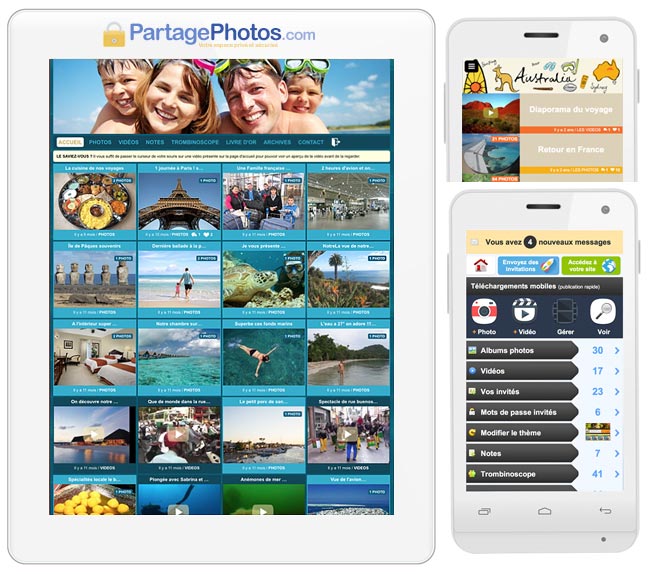
Here is an example of a cloud photos/videos, a kind of confidential, private and secure blog, completely invisible on search engines.
What are the risks when trusting your files to American clouds?
 American cloud services, such as iCloud, Dropbox or Google Drive, can present certain risks in terms of confidentiality and security.
As I mentioned at the beginning of this article, one of the main problems comes from American laws, such as the Cloud Act, which allow the United States government to request access to your data, even if it is stored outside the United States.
This can be problematic for those who want to keep their files strictly private.
Moreover, these platforms are prime targets for hackers. Cyberattacks on giants like Facebook or iCloud have already shown that even the largest companies are not spared. For example, in 2014, a massive attack on iCloud led to the leak of personal photos of celebrities. These incidents show that entrusting your files to these platforms can involve significant risks.
Finally, social networks like Facebook or Instagram can pose even more problems in terms of privacy. By using this type of social network, your data is at the mercy of advertisers, but worse, of hackers.
By posting family photos or private videos on these networks, you often lose control over their use. To avoid these problems, it is best to choose a secure and privacy-respecting service.
Is a cloud backup really safe for personal photos and videos?
A Cloud backup security depends on the provider's encryption methods and data storage location. While major services offer encryption, your files are stored on foreign servers, potentially accessible by third parties. For sensitive personal photos and videos, a European-based secure sharing service with end-to-end encryption and GDPR compliance offers better privacy protection than traditional cloud backup solutions.
What are the main risks of using cloud?
The main risks include data breaches from cyberattacks, unauthorized access by service providers or government agencies, loss of control over your files, potential data mining for advertising, and dependency on internet connectivity. Additionally, most cloud backup terms allow providers to scan your content, and data may be stored in countries with weaker privacy laws than Europe.
What's the difference between cloud backup and secure photo sharing?
Cloud backup stores copies of your files on remote servers primarily for recovery purposes, while secure photo sharing focuses on controlled, encrypted sharing with specific people. Secure sharing platforms offer features like password protection, expiration dates, download controls, and European data hosting. Unlike generic cloud backup, they prioritize privacy over convenience and don't scan your content for advertising.
How can I secure my photo backups without using cloud storage?
Alternatives include using external hard drives with encryption, NAS (Network Attached Storage) devices at home, or European secure photo sharing platforms that offer private albums with encryption. You can also combine methods: keep local encrypted backups and use a privacy-focused European service for sharing. This approach gives you full control while maintaining accessibility for family members without exposing your photos to mass surveillance or data mining.
Say goodbye to social media risks
Create your 100% private photo sharing space in 2 minutes to share photo albums and videos with your contacts securely
✅ Create Your SpaceFAQ about « Cloud backup »
- How to delete a cloud backup on iCloud?
- Cloud backup security issues
- Cloud backup advice before activating
- How to avoid automatic cloud backup?
- The limits of iCloud photos and potential risks
- I’m looking for a French cloud backup service
- Where to post videos of your children with peace of mind?
- Can you trust Facebook for your family photos?
- Where to create a password-protected cloud backup for personal photos
- Private space to share photo albums without risk
