
Alternative to Google Photos for sharing photos — Google Photos is one of the most widely used photo storage applications in the world. Practical, automatic, and free up to 15 GB: it seems to be the obvious solution for storing and sharing your photos. But when you look more closely at its terms of use, its personal data practices, and its limitations for truly private sharing, legitimate questions arise. This article honestly compares Google Photos and presents alternatives for those who want to maintain control over their photos.
Google Photos: what is it really for?
 Google Photos addresses a fundamental need: never losing your photos again. With dedicated storage space for your photos, many internet users place complete trust in Google’s service.
However, like most online services, there are both advantages and disadvantages worth considering. It is truly important to be well informed about the service you will use to publish, share, and store your files.
It bears reminding that photos and videos are personal data — and as such, the choice of platform, application, or cloud service used clearly deserves careful consideration.
Thanks to automatic synchronization, every photo taken with your smartphone is immediately saved to the cloud, without any action on your part.
This is its main strength — and precisely why billions of people use it without giving it much thought.
Google Photos is a product of Alphabet Inc., whose business model is based on advertising and the exploitation of user data.
This reality has direct consequences on how your photos are processed — which we detail in our complete article on Google Photos.
The strengths of Google Photos
Automatic synchronization and intelligent organization
Google Photos automatically synchronizes all your photos from your Android or iPhone smartphone.
The application creates automatic albums, recognizes faces, places, and events — and offers memory recaps. To find a photo taken 5 years ago in Lyon in the snow, simply type « Lyon snow » in the search bar.
This is impressive technology that makes the service very convenient for everyday use.
15 GB of free storage
Google offers 15 GB of free storage shared between Google Photos, Gmail, and Google Drive. Beyond that, you need to subscribe to Google One — starting at €1.99 per month for 100 GB, up to €29.99 per month for 2 TB.
Accessible from any device
Google Photos is available on Android, iOS, and from any web browser. This is a major advantage for families using different devices — Android, iPhone, PC, Mac.
The limitations of Google Photos for private sharing

Your photos analyzed by algorithms
To enable face, place, and object recognition, Google Photos analyzes the content of each photo stored on its servers.
This means that algorithms concretely « see » your personal photos — photos of children, family photos, and intimate moments.
This is not an interpretation: it is how the service technically functions, and it is essential for powering its automatic organization features.
Shares that can be public
When you share an album via Google Photos, a public link is generated.
Anyone who has this link — even if you did not send it to them directly — can access the content. There is no system for controlling access by guest: it is impossible to know who actually viewed your photos, or to revoke access from a specific person.
American servers and the Cloud Act
 Google is an American company subject to the Cloud Act, a law that requires American technology companies to grant US authorities access to data stored on their servers, including data hosted in Europe.
For personal photos — and even more so for photos of children in a professional context — this is a legal and ethical risk that must be taken seriously.
Advertising fueled by your data
Google’s business model is based on targeted advertising. Data collected via Google Photos — places visited, events, people photographed — helps refine the advertising profile that Google builds on each user. The metadata from your photos (date, location, device) is indeed used for commercial purposes.
Not suitable for photos of children in a professional context
Google Photos does not offer the features required for sharing children’s photos in a professional context compliant with GDPR — no parental consent management, no access traceability by family, and no control over who sees which photos.
We detail these obligations in our guide on GDPR and online photos.
What are the real dangers of Google Photos for my family?
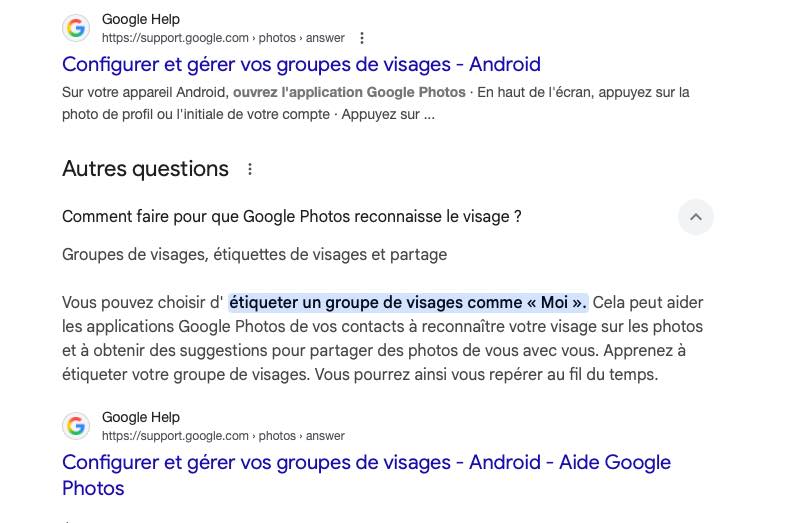 Let’s be honest: Google Photos is not the enemy, but it presents very real risks that few people fully appreciate.
First danger: loss of image rights. By accepting the terms of use (you know, those dozens of pages nobody ever reads), you grant Google certain rights over your content. You remain the owner of your photos, but Google may use them to « provide, maintain, protect and improve its services. » In practice, your photos may be used to train Google’s artificial intelligence.
Second risk: hacks and data breaches. Google is a prime target for cybercriminals. In 2019, a flaw in Google+ exposed the data of 52 million users. In 2023, security researchers discovered that some « deleted » photos remained accessible via direct links. Your personal photos are never completely safe on a platform used by billions of people.
Third danger: accidental exposure. How many times have you heard of someone who accidentally shared an entire album publicly? Google Photos privacy settings can be complex, and a simple mistake can expose your family photos to the entire world. With a platform dedicated to private sharing, albums are protected by default — you must actively invite people with a password for them to gain access.
Google Photos vs Partagephotos.com comparison
| Criteria | Google Photos | Partagephotos.com |
|---|---|---|
| Free storage | ⚠️ 15 GB | ⚠️ Trial version |
| Photo analysis by AI | ⚠️ Yes | ✅ No |
| Truly private sharing | ❌ Public links | ✅ Password-protected |
| Access management by guest | ❌ No | ✅ Yes |
| Collaborative contributions | ⚠️ Limited | ✅ Yes |
| Hosting | ⚠️ USA / EU | ✅ Switzerland |
| Subject to Cloud Act | ⚠️ Yes | ✅ No |
| Advertising / data collection | ⚠️ Yes | ✅ No |
| No sign-up required for guests | ❌ Google account required | ✅ Yes |
| Suitable for GDPR organizations | ❌ No | ✅ Yes |
| Automatic synchronization | ✅ Yes | ❌ No |
✅ Favorable | ⚠️ Partial or limited | ❌ Not available | Updated February 2026
When Google Photos remains a suitable choice
Google Photos remains an excellent solution for personal automatic backup. If you simply want to avoid losing your photos and be able to find them easily across your devices, without any particular concern about private sharing, it fulfills this role perfectly.
Automatic synchronization, intelligent search, and data recovery when switching phones are all very valuable features.
Recurring bugs reported by users
Beyond privacy concerns, Google Photos suffers from technical issues regularly reported by its user community.
Photos that disappear and then reappear for no apparent reason, synchronization bugs between the web and mobile versions, old photos altered with visual artifacts after editing — forums and Reddit threads are full of testimonials from frustrated users.
For a service meant to protect your memories, these recurring instabilities raise a real question: can you confidently entrust all your personal photos to a platform prone to such malfunctions? User feedback on Reddit speaks for itself.
Is it complicated to migrate to an alternative to Google Photos?
 Rest assured, switching to an alternative to Google Photos is not that complicated. You do not need to be a tech expert to create your private photo space.
The process is straightforward: you create your space by entering a name and your email address, customize your gallery if you wish, create your first albums, and invite your loved ones by email. They receive a link and a password — no registration required on their end, no Google account needed.
To transfer your photos from Google Photos, you can download them by album using Google Takeout, then upload them to your new platform. It takes a little time if you have thousands of photos, but a few hours of transfer for years of peace of mind is well worth it.
When to look for an alternative to Google Photos
As soon as the need involves truly private and controlled sharing, Google Photos reaches its limits.
This is the case when you want to share photos with your family while ensuring that only the people you have invited have access. When you are a professional organization — daycare, after-school center, recreation center — and you need to share photos in compliance with GDPR. When you want to create a collaborative space where multiple people can contribute their own photos.
See our comparison of 12 photo sharing solutions for a complete overview.
Partagephotos.com: an alternative to Google Photos for private sharing
Partagephotos.com is a private photo sharing platform, hosted in Switzerland, with no advertising and no data collection. Unlike Google Photos, no algorithm analyzes your photos, and your guests can access your space without creating a Google account or installing an application.
What Partagephotos.com offers that Google Photos does not
A space protected by a password that you set and share only with the people of your choice. Precise access management per guest — some can only view, others can upload their own photos. Hosting in Switzerland, outside American jurisdiction and outside the scope of the Cloud Act. No data resold, no advertising displayed.
For families as well as professionals
Whether you are a family looking to create a secure family photo sharing space, a couple preparing a collaborative wedding album, or an organization sharing activity photos with families in compliance with GDPR — Partagephotos.com is a serious alternative to Google Photos, with no dependence on GAFAM.
What is the best alternative to Google Photos?
The best alternative to Google Photos is a secure, GDPR-compliant platform that prioritizes privacy and data protection. Unlike American services, French alternatives keep your data in Europe, offer ad-free experiences, and don't use your photos for AI training or targeted advertising. They provide unlimited storage, easy sharing options, and complete control over your memories.
Is there a privacy-focused alternative to Google Photos?
Yes, there are several European alternatives to Google Photos that respect GDPR regulations and European data sovereignty. These platforms offer secure photo storage and sharing without tracking, data mining, or advertising. These services keep your data on European servers, ensuring better privacy protection and compliance with EU data laws.
Why choose a European photo sharing platform over Google Photos?
European photo sharing platforms offer superior privacy, no ads, GDPR compliance, and European data storage. Your photos aren't used for AI training or advertising profiling. You get complete ownership of your data, no account linking to other services, and support for European privacy values. Plus, your family's memories stay secure on European servers.
Are European photo storage services safe and secure?
Yes, European photo storage services are highly secure and safe. They comply with strict GDPR regulations, use encrypted connections, store data exclusively on European servers, and don't share information with third parties. Unlike American platforms, they prioritize user privacy over data monetization and offer transparent privacy policies.
Does Partagephotos.com use AI to scan my photos?
No, Partagephotos.com does not use AI to scan, analyze or process your photos. Unlike Google Photos and other American platforms, your images remain completely private and confidential. There is no facial recognition, no object detection, no machine learning training on your memories. Your photos are simply stored securely on European servers with GDPR compliance, encrypted connections, and zero data mining. What you upload stays yours, unseen and unanalyzed by any artificial intelligence system.
Discover a private sharing solution
Create your 100% private sharing space in 2 minutes to share photo albums and videos with your selected contacts
✅ Try the demoFAQ on « alternative to Google Photos »
- free alternative to Google Photos
- alternative to Google Photos without AI analysis
- alternative to Google Photos for families
- alternative to Google Photos GDPR children’s photos
- private photo sharing without a Google account
- photo cloud hosted in Europe without GAFAM
- alternative to Google Photos daycare recreation center
- family photo sharing without social networks
- private photo cloud without advertising
- alternative to Google Photos Switzerland hosting
- secure photo sharing without Cloud Act
- alternative to Google Photos without automatic synchronization
- What is the best alternative to Google Photos for family sharing?
- How to create a private and secure photo space?
- What are the risks of using Google Photos?
- Secure photo sharing app without GAFAM
